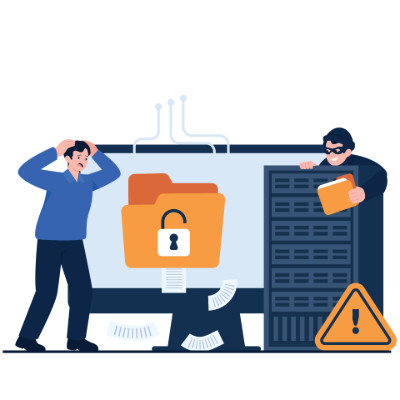


Does the idea of cybersecurity strike fear into your heart? We know it’s not every business’ specialty, but that doesn’t make it any less important for companies like yours to consider. Today, we want to make it as easy as possible for your employees to practice appropriate cybersecurity measures, and that starts with a simple one-page cybersecurity cheat sheet.
The AI Revolution is no longer a futuristic headline, it’s quickly becoming the operating system of the modern economy. As a business owner, you’ve likely already identified the AI tools you want to implement to stay ahead. The hard truth is that the best AI strategy in the world will fail if your team doesn't know how to use it safely and effectively.
For years, we’ve seen the future of work as an abstract, distant concept that would eventually remove us from our cubicles. It has become abundantly clear that the future has arrived. The Mobile Office is no longer defined by a solitary laptop perched on a kitchen table or a temporary desk in a spare bedroom. Instead, it has evolved into a highly sophisticated, decentralized ecosystem of interconnected devices and cloud services that demands significantly more from IT infrastructure and support teams than ever before.
The greatest vulnerability in your business’ network security actually has nothing to do at all with the systems in place. It’s actually your employees who will ultimately put your company at risk. Hackers rely on the fact that your team is busy, stressed, and trying to be helpful, and this helps hackers engineer moments where employees will click first and ask questions later, much to your business’ detriment.
We will be the first to admit it: we are obsessed with security.
In an era where cybercriminals are more sophisticated and persistent than ever, that obsession is a necessity. Modern security requires a fundamental shift in mindset: you cannot implicitly trust anyone. Not outside hackers, and—uncomfortable as it may be—not even the people inside your organization.
This trust-no-one approach is the foundation of Zero-Trust Security.
If you still view your IT department as a mere secondary expense, you are likely overlooking the most significant threat to your company's profitability. In today’s landscape, digital infrastructure isn't just a static utility; it is the very plumbing of your revenue. It functions as either a reinforced vault protecting your hard-earned gains or a porous sieve where your margins quietly drain away. To truly safeguard your legacy, you must look past the technical jargon and recognize a fundamental truth: cybersecurity isn't a tech problem relegated to a basement office—it is a direct and measurable pillar of your financial stability.
Have you ever stopped to ask yourself if the person you’re talking to on the phone is an AI system or an actual, honest-to-goodness human? It’s expected that in 2026, you’ll be asking this question a lot more often—especially with the rise of agentic AI. This development takes the vulnerability that already exists in your human infrastructure and attempts to make it impossible to stop. Today, we’ll explore agentic AI, what it looks like, and what you can do to put a stop to it in the years to come.
We’re sure at some point you’ve used the idiom, “If it ain’t broke, don’t fix it,” particularly in regards to your IT. While it might feel responsible and safe to stick to this motto as much as possible, there will come a time when it becomes dangerous to hold fast to it. In fact, business technology professionals might even call this motto irresponsible. Here’s why.
As we stand on the threshold of a new year, it’s worth noting that the term "cybersecurity" didn't even enter the common lexicon until the late 1980s. Before that, we just called it "computer security"—mostly involving locking the server room door and hoping nobody guessed the password was "admin."
Fast forward to today, and the game has changed entirely. "Hoping for the best" is no longer a viable business plan. As you prep your resolutions, it’s time to hit the ground running with a cybersecurity posture that is as modern as the threats we face—a goal that will require training for your entire team.
With AI now being used by adversaries to reverse-engineer patches and generate exploits in hours rather than weeks, our old Patch Tuesday rhythm is essentially an open invitation to hackers. The truth is, the patching gap is a competitive weakness.
If we want to protect our organizations without drowning our teams in manual toil, we have to stop treating patching as a checklist and start treating it as a dynamic, intelligent discipline. Here is how we’re rethinking the vulnerability situation.
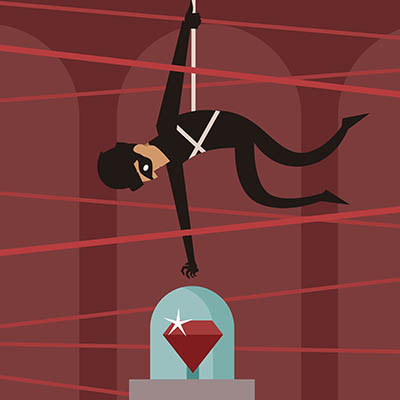
It would seem that the people responsible for the recent heist at the Louvre, which netted over $101 million in jewelry, may have used a more complicated plan than strictly necessary. According to a French publication, the famous museum has a long history of cybersecurity mistakes and faux pas… many of which, given the museum’s fame, are truly shocking.
Let’s go over what we know about the Louvre’s protections over the years, and what they suggest about the current state of things. We’ll probably learn a thing or two by doing so.
An old fable says that a frog placed in a pot of boiling water will jump out immediately, but if the water is warmed to boiling with the frog already in it, the frog won’t notice until it is already too late. Many businesses today act like that frog, overlooking minor tech issues that signal a growing problem until the damage is done.
Let’s see if we can identify some of these issues to help keep you out of hot water.
How many employees do you have who keep your company’s passwords on sticky notes stuck to their monitors? This simple, seemingly benign trick could be putting your business at risk. After all, if you can see the password on a sticky note, so too can others who happen to be wandering around the office—including potential threat actors.
Passwords are effectively the cornerstone of your business’ data security. If they aren’t up to muster, your protections could crumble. Unfortunately, many users shortchange their passwords to try to make them more convenient, also making them more convenient for cybercriminals. Let’s see how we could (and should) make passwords as effective as possible.
Cyberthreats are no longer rare occurrences; they are constant, evolving, and frequently highly sophisticated. This reality makes a proactive approach to cybersecurity absolutely essential. Organizations that only react to attacks find themselves perpetually engaged in damage control.
Failing to establish a deliberate, comprehensive cybersecurity strategy exposes any organization to repeated breaches, critical data loss, and ultimately, a loss of customer trust that can lead to financial collapse. This overview details why addressing these persistent risks is critical for the success of any contemporary business.
The scariest online threats are the ones you don't even see coming. Picture this: a hacker tricks one of your employees with a sneaky phishing email, steals their username and password, and just walks right into your network. No alarms, no warning.
The really good news is there's a simple fix that can make a huge difference: Multi-Factor Authentication (MFA). Just setting this up is one of the biggest steps you can take to make your business much safer and a lot less likely to suffer a nasty cybersecurity breach.